
Insurance eligibility & benefits verification
Know what is covered before the visit.
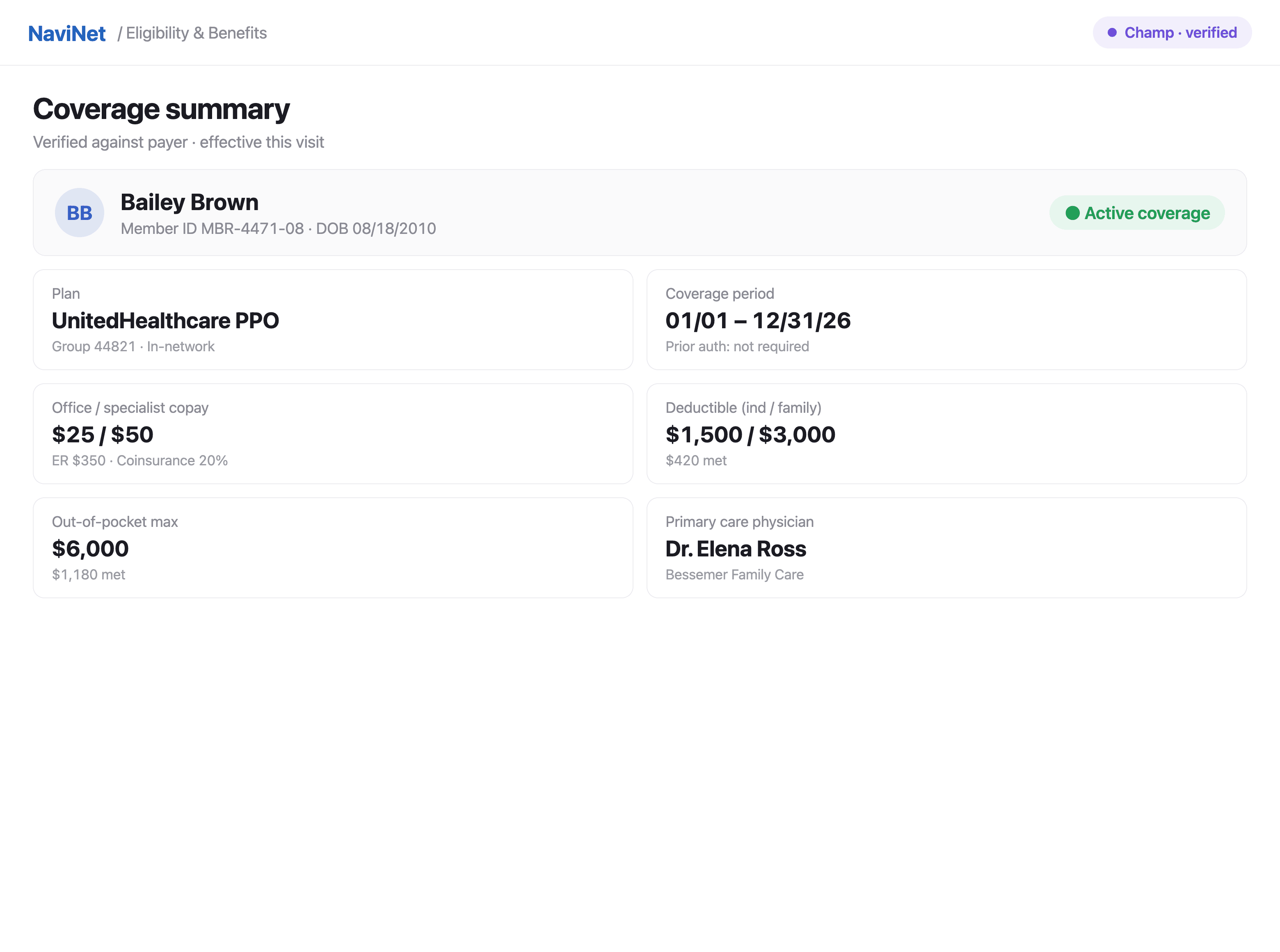
A standard eligibility response tells you coverage is active. Champ answers whether you can treat this patient, under this plan, and get paid.
40%
of verifications still worked by hand in portals
1 in 4
claim denials start with eligibility errors
$18.4B
left on the table in eligibility every year
The operational bottleneck
A transactional response is not the complete answer.
Eligibility APIs and clearinghouses are useful inputs, but complex coverage is split across transactions, government systems, managed-care portals, documents, and plan-specific rules. Staff still have to find the operational answer and prove how they reached it.
Bring us your workflowMedicare FFS, Medicare Advantage, and Part D eligibility require different systems and inquiry paths
Medicaid coverage, managed-care assignment, share of cost, and benefit detail vary by state and plan
Medi-Cal ECM qualification combines managed-care enrollment with Population of Focus criteria and supporting evidence
A standard 270/271 response may omit service-specific, authorization, referral, network, and program detail
The production workflow
One continuous operation, not another disconnected tool.
Champ coordinates browser, document, API, voice, and human steps around the outcome your team is responsible for.
- 01Validate the patient and appointment
Confirm demographics, subscriber details, payer, service dates, provider, and scheduled procedure before verification begins.
- 02Check every available source
Run the eligibility transaction, then continue into Medicare, state Medicaid, managed-care, and payer systems when the response does not answer the operational question.
- 03Resolve the program-specific path
Normalize coverage and benefits, identify the responsible plan, evaluate approved program criteria, collect supporting evidence, and determine the next enrollment or referral step.
- 04Write back and resolve exceptions
Update the EHR or practice-management system, recheck on schedule, and route conflicting or incomplete results with the evidence attached.
Why it stays reliable
Built around the work, not a brittle integration map.
Your systems can stay exactly where they are. Champ operates across them, records what happened, and improves the workflow as the process changes.
CHANGE THE OPERATING MODEL
Three ways to run eligibility. One that finishes.
What each approach returns once the answer is not in the transaction.
| What the check has to answer | EDI / clearinghouse270/271 or an eligibility API, on its own | Manual follow-upStaff working payer portals behind the response |  ChampOne workflow, operated in production ChampOne workflow, operated in production |
|---|---|---|---|
| Active coverage and responsible plan | Yes. Returned in seconds | Yes. Confirmed by hand | Yes. Confirmed and rechecked on schedule |
| Benefits, authorization, and program detail | No. Generic or missing from the response | Yes. Looked up payer by payer | Yes. Completed in the same run |
| More than one source reconciled | No. One response, one opinion | No. Too slow to run routinely | Yes. Sources compared, conflicts resolved |
| Portal, phone, and fax follow-up | No. Out of scope | Yes. The bulk of the work | Yes. Browser, voice, and document agents |
| Evidence behind the answer | Partly. The raw 271 only | Partly. Notes, when there is time | Yes. Screenshots, timestamps, and reference numbers |
| What more volume costs you | Partly. The same gap, more often | No. More headcount | Yes. More completed verifications |
More healthcare workflows
One platform across the back office.
Champ runs the same way across the rest of revenue cycle and compliance operations.






Insurance eligibility & benefits verification FAQ
Questions healthcare operators ask first.
You have more questions?
Send us an email